 poppivo
SEAMKEEP is a small merge puzzle where the empty spaces remember your moves. Tap two equal patches in the same row or column and they join. The first patch moves into the second, grows to the next size, and leaves a stitched seam behind.
Try SEAMKEEP in the browser demo for free. There is no timer, no required account and no app to install. Take a moment before every merge; the board will wait.
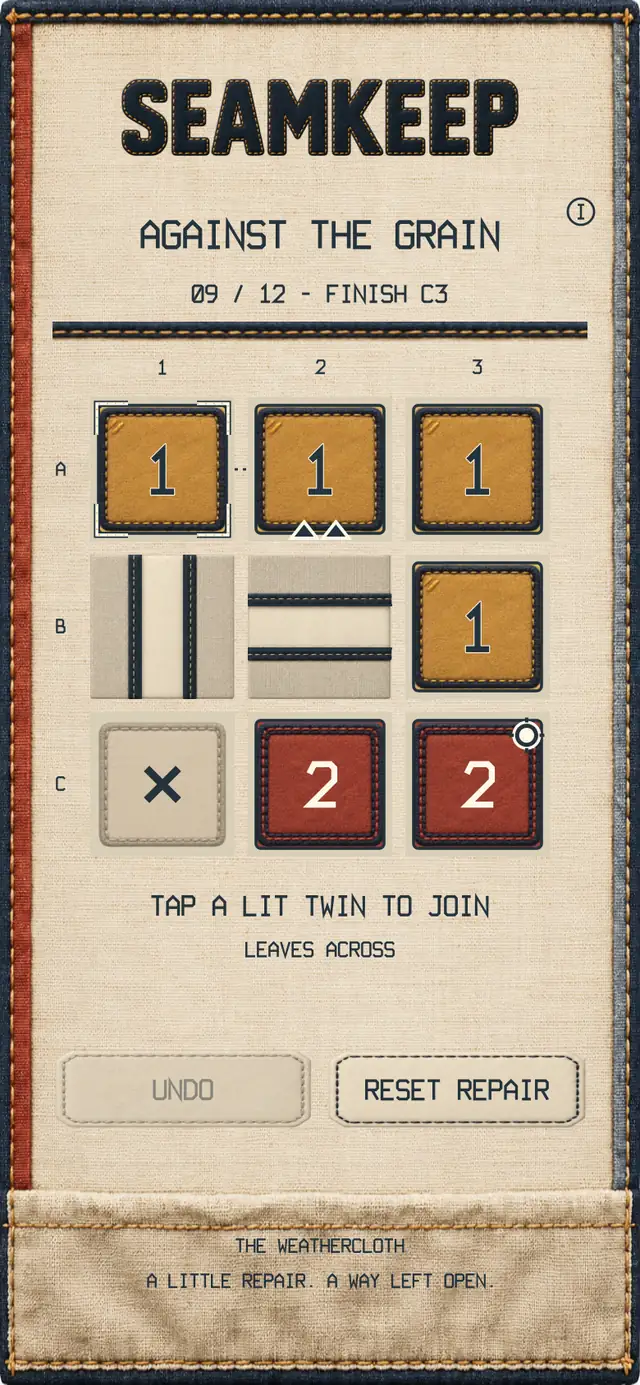
The second patch stays
Your first tap selects the patch that moves. Your second tap chooses its destination. The destination stays in place and grows. This makes the same pair worth looking at in both directions: which position do you want to keep, and where will you need a route later?
After you select a patch, the game rings the matching patches it can legally reach and shows a thread along the path. Tap the selected patch again to let go, or tap another patch to change your selection. Use those highlights to check a move before committing to it.
Which patches can join?
- The two patches must be equal and share a row or column
- Adjacent equal patches can join directly
- Separated patches need a clear route through correctly oriented seams
- A horizontal move needs across seams; a vertical move needs down seams
- Pins block the route
A seam across a row is useful for a later horizontal join. It does not become a vertical road just because the cell is empty. That is why clearing space can leave you with fewer useful moves if you clear it in the wrong direction.
Think one merge ahead
Before joining a pair, look for the patch that the result could eventually meet. Will they share a row or column? If there is a gap, will the seam you are about to leave support that direction? You do not need to calculate the whole board immediately, but one extra step can reveal a merge that strands its result.
When two choices look similar, compare their destinations. Keeping a larger patch in a central route and keeping it at an edge can leave very different options. The right answer depends on the current swatch, its pins and the other patches, so there is no rule that every merge should move inward.
How a swatch ends
Reduce the swatch to a single patch to score it. The next swatch appears immediately. If at least two patches remain and no equal pair can reach one another, the run ends. An empty-looking board is not necessarily a solved board: the remaining patches still need a legal way to meet.
There is no countdown or refill to wait for. A useful first goal is one solved swatch with a clear understanding of why its final pair could join. On the next attempt, pay attention to the move that created the final route.
Touch and keyboard controls
On a phone, tap a patch and then its twin. On a keyboard, 1–9 selects the nine cells from A1 to C3. Q W E, A S D and Z X C also map to the three rows. You can tab to a labelled cell and press Enter.
Patch sizes are written as numbers, seam directions use visible geometry, and legal destinations are highlighted. You do not have to distinguish colours to understand a merge. The challenge comes from reading the spatial route and deciding what to leave behind.
For a faster game where your old turns also matter, try the BENDLIGHT guide. Its temporary mirrors turn previous movement into a new opportunity.